

All businesses have always needed advertising to promote their products or services. The internet has served as a channel to facilitate the distribution of our advertising to third parties, or vice versa, allowing brands to advertise on our own website. In its early days, digital advertising appeared almost exclusively in the form of static banners , but the evolution of user behavior and visual saturation led to the development of these formats into more interactive and sophisticated options.
Today, advertising formats are so diverse that choosing the right one can be overwhelming. It's not just about placing an ad; it's about understanding that programmatic advertising and format selection can dramatically change a campaign's chances of success. The goal should always be twofold: to increase advertising revenue or brand visibility while keeping users engaged and satisfied.
To achieve this, it's crucial to understand that ad formats determine how the creative (whether video, image, or audio) will be displayed and the level of user interaction. An incorrect choice can lead to a high bounce rate, while a strategic choice improves CPM (Cost Per Mille/Thousand Impressions) and CTR (Click-Through Rate).
Traditional Banner Ads and Page Stealers
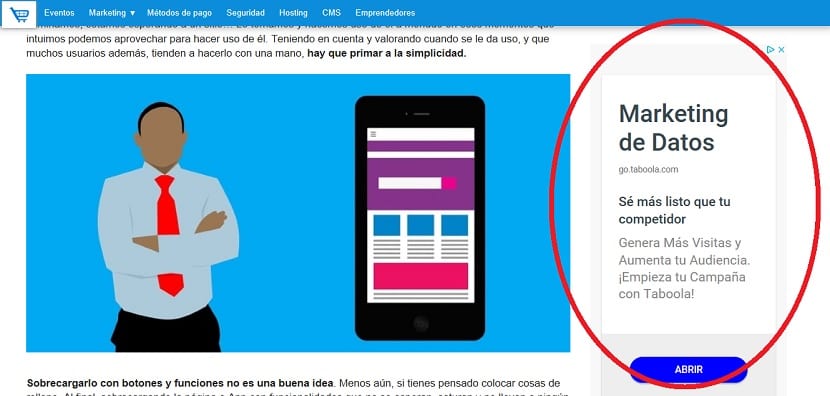
The banner ad is currently one of the most in-demand formats . Its main advantage lies in its versatility: thanks to its size, it can be displayed on almost any website, regardless of the design structure. It typically appears in sidebars , allowing users to consume the main content without the ad being overly intrusive.
Within the banner category, we find various names depending on their position. If they are placed horizontally, they are known as Leaderboards or Billboards ; if they are vertical, they are called Skyscrapers or half-page ads (HPAs). To maximize visibility, it is vital to place them in strategic areas where the user's eye naturally rests.
The most widely accepted and used page-stealing formats by web platforms are:
- Medium Rectangle Page RoboIt measures 300 x 250 pixels, with a standard file size of 30kb. It is one of the most compatible and best performing.
- Square Page Stealer: A square format of 300 x 300 pixels, also with a weight of 30kb.
- Splitscreen Page Stealer: Elongated format, 300 x 600 pixels and a weight of 30kb, ideal for capturing attention while scrolling.
It is important to mention that these versions can be implemented in an expandable way , allowing the ad to grow as users interact with it, thus increasing the engagement rate.
Interstitial: The total impact format
An interstitial ad, also known as a banner ad , is an advertisement that appears during a browsing process. Its main characteristic is that it occupies the entire page , blocking the view of the content until the user closes it or the display time expires.
Although this format is a significant source of revenue because it guarantees ad impressions, its use has been declining. The reason is clear: it's very intrusive for users and negatively impacts User Experience (UX) , hindering smooth navigation. Previously, they served to entertain while the website loaded, but nowadays, with current connection speeds, they can generate rejection and increase abandonment rates.
Pop-ups and Pop-up Windows

Pop-ups function similarly to interstitials but are smaller and appear when specific actions are performed, such as hovering the mouse over an element or after spending a certain amount of time on the page. While effective for lead generation, they are off-putting to many users. This has led most modern browsers to include built-in pop-up blockers , which reduces their actual reach.
Billboard: The visibility giant
The billboard is a megabanner measuring 970 x 250 pixels . It's typically placed at the top of a website. Unlike standard banners, its extra height gives it a massive visual impact. The billboard's main objective isn't necessarily immediate clicks, but rather generating brand awareness and making a strong impression on the user.
Skin: Immersive Customization

The Skin format involves customizing the background, header, and sidebars of a page with the visual identity of a specific campaign. It's one of the most elegant forms of advertising, as it envelops the content without interrupting it. It can integrate dynamic videos and is highly valued by users because it doesn't negatively impact the browsing experience.
Video Advertising: Pre-roll, Mid-roll and Post-roll
Video is currently king of content. Depending on their place in the timeline of audiovisual content, they are classified as follows:
- Pre-rollThey appear at the beginning. They can be mandatory or include the button "skip ad" If they exceed a certain duration. They are ideal for capturing immediate attention.
- Mid-rollThey are inserted in the middle of the video, similar to television commercials. They are very effective in long content (more than 10 minutes).
- Post-rollThey appear at the end of the video. Their challenge is greater, as they must contribute a extra value to retain a user who has already consumed the main content.
Rich Media: Advanced Interactivity
Unlike traditional display ads, rich media ads are interactive and incorporate sound, video, animations, and elements that require user action. They are generally developed using HTML5.
Their success is remarkable: users tend to click up to four times more than on traditional banners, and if the creative is disruptive, this rate can increase to nine times. Furthermore, they allow for detailed metrics on specific interactions (expansions, viewing time, etc.).
Native Advertising
Native advertising is designed to blend seamlessly into its surroundings. It doesn't look like an ad, but rather part of the editorial content. It typically consists of an image, text that's consistent with the medium, and a subtle Call to Action (CTA).
Its benefits are clear: it reaches users who have developed "banner blindness" or who use ad blockers, it improves brand reputation by not being intrusive, and it generates high CPMs and CTRs due to its contextual relevance.
Specialized Formats in Google Ads and Display
For those using the Google ecosystem, there are specific formats that optimize conversion:
- Text AdsShort, concise, and keyword-based. They appear in search results and are essential for capturing direct demand.
- Dynamic BannersThey use sections that change depending on the product the user has previously viewed. They are the star tool for marketing campaigns. Remarketing.
- Shopping AdsEssential for e-commerce. They display the product image, price, and description directly in the search results, facilitating immediate comparison.
- Dynamic Search Ads (DSA)Google automatically creates the ad by analyzing website content and user search terms. Ideal for very large catalogs.
- Trueview (YouTube)Video format with a paid model CPV (Cost Per View)where the advertiser only pays if the user watches the first 30 seconds or the entire video.
Social Media Advertising (Social Ads)
The Meta platforms (Facebook and Instagram) and Twitter offer formats adapted to fast and mobile consumption:
- Carousel AdsThey allow you to display multiple products or steps in a process in a single ad, increasing interactivity.
- Collections and Canvas: Full-screen immersive experiences designed exclusively for mobile devices, functioning as a digital showcase.
- Reels Ads and Short VideosThe vertical format is currently the most powerful. The key is that the content feels natural and not like a traditional TV commercial.
- Adaptive Ads: They use Machine Learning to automatically combine text and images based on location (feed, stories, etc.) to optimize performance.
- Lead Generation AdsThey allow you to capture user data (name, email) through an internal form without the user having to leave the social network.
Strategy according to the Conversion Funnel
To achieve the best ROI, the format should be adapted to the stage the user is in:
1. TOFU (Top of the Funnel) Phase – Attraction
At this stage, the user is unfamiliar with the brand. We are seeking brand awareness.
- Video Ads and Social AwarenessTo tell the brand's story and generate visual impact.
- Display Advertising and Digital Signage: To generate massive recognition.
- Content MarketingOrganic attraction through real value.
2. MOFU (Middle of the Funnel) Phase – Consideration
The user already knows they have a need and compares options:
- Social Remarketing: To impact those who have already visited the website.
- Discovery Social AdsCampaigns based on competition or specific interests.
- Affiliation MarketingPromotions on third-party sites to gain credibility.
- Lead Generation Emailing: Direct communication through segmented databases.
3. BOFU (Bottom of the Funnel) Phase – Decision
The user is ready to buy. We're looking for conversion.
- Social and Lookalike Retargeting: Target users with high purchase intent or profiles similar to current buyers.
- SEM (Search Engine Marketing)Campaigns branded (branded) and non-branded to capture the final sale.
- Membership through coupons and cashback: Direct incentives to close the transaction.
- Conversion-Oriented SEO: Positioning in transactional keywords.
Keys to optimizing advertising implementation
Choosing the format isn't enough; execution is what determines success. To prevent advertising from backfiring, follow these guidelines:
- Don't saturate the spaceFilling the web with ads may increase revenue in the short term, but it destroys user retention. Fewer ads in certain places. highly visible They perform better than many ignored ads.
- Pay attention to the loading speedVideo and rich media are large files. An excess of these elements can slow down the site, affecting performance. SEO and UXIt uses optimized formats and lazy loading.
- Constant A/B TestingDon't rely on intuition. Test different creatives, CTA colors, and sizes. Measure not only the CTR, but also the final conversion rate.
- Adaptable OmnichannelCreate a modular creative base. What works in a 300x250 banner should be able to quickly adapt to a Reel or a text ad on Google.
- Precise SegmentationFocus on a specific market segment. The better you know your target audience, the better you can target them. Buyer PersonThe more effective the chosen format will be.
Digital advertising is a dynamic ecosystem that evolves with technology and consumer demands. The balance between monetization and user satisfaction is key to maintaining consistent traffic. A flexible, data-driven, and user-centric strategy allows any business to scale its results without compromising the integrity of its web platform. Choosing the right format, on the right channel, and at the precise moment in the sales funnel is what transforms a simple impression into a real sale.